


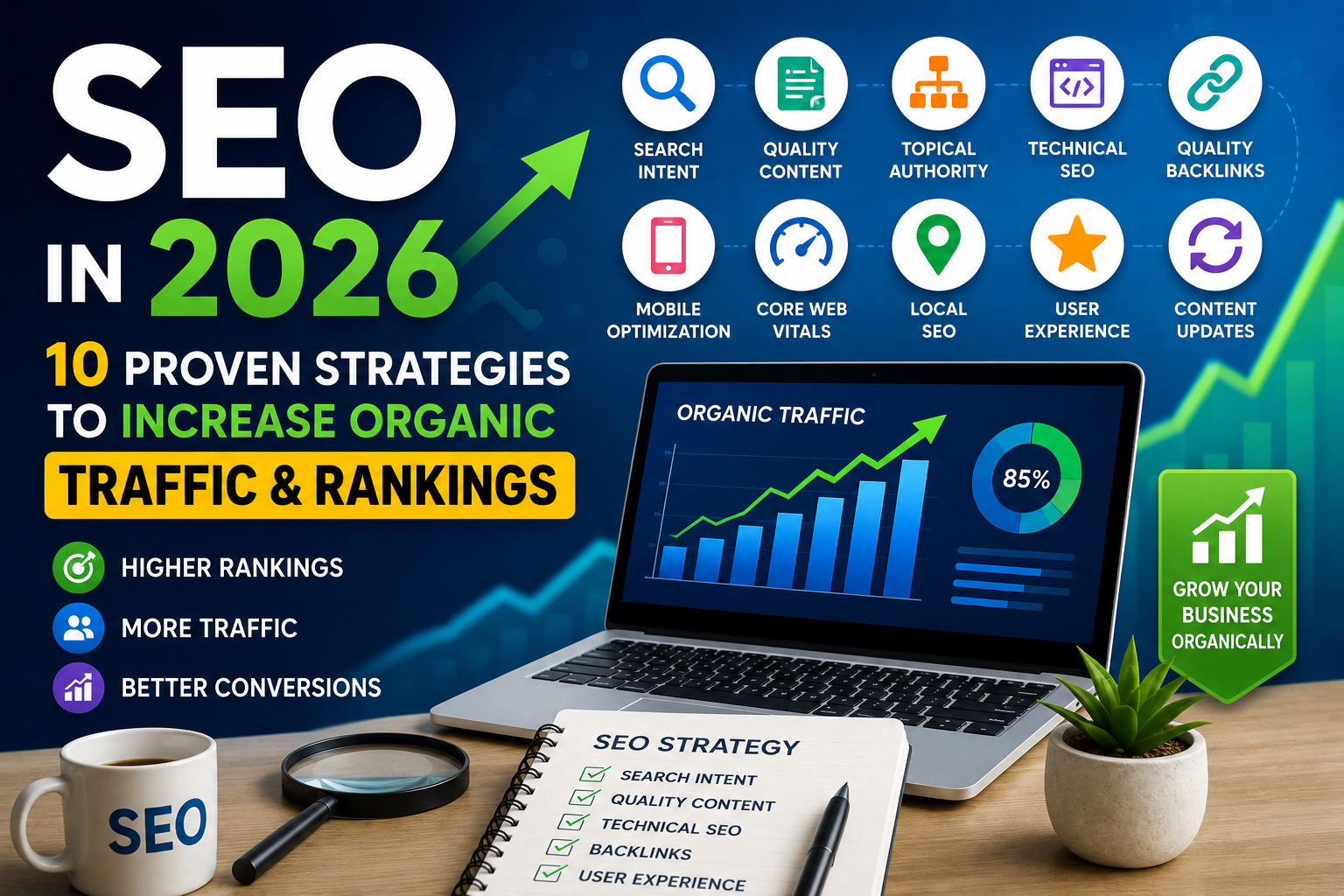
Search Engine Optimization (SEO) continues to evolve rapidly as Google integrates artificial intelligence, user behavior signals, and advanced content evaluation systems into its ranking algorithms. In 2026, businesses that rely on outdated SEO techniques are finding it increasingly difficult to compete in search results.
Whether you run a local business website, an eCommerce store, a blog, or a service-based company, understanding modern SEO strategies is essential for sustainable growth.
This guide explores the top SEO strategies that are helping websites improve rankings and generate more organic traffic in 2026.
Why SEO Matters More Than Ever
Organic search remains one of the highest-converting traffic sources available. Unlike paid advertising, SEO provides long-term visibility and continues generating traffic even after content is published.
Benefits of SEO include:
- Increased website traffic
- Better brand visibility
- Higher conversion rates
- Improved user experience
- Long-term lead generation
- Greater trust and authority
As competition grows across every industry, businesses that invest in SEO gain a significant advantage.
1. Focus on Search Intent Instead of Keywords
One of the biggest SEO shifts in recent years is Google’s emphasis on search intent.
Rather than simply matching keywords, Google now aims to understand what users actually want when performing a search.
For example, someone searching:
“Best SEO tools”
may want:
- Reviews
- Comparisons
- Pricing information
- Feature breakdowns
Instead of creating content around keywords alone, focus on answering the user’s complete question.
How to Optimize for Search Intent
- Analyze top-ranking competitors
- Understand what users expect
- Create comprehensive answers
- Include FAQs
- Cover related questions
Content that satisfies search intent often ranks higher than content with perfect keyword density.
2. Build Topical Authority
Google increasingly rewards websites that demonstrate expertise in specific topics.
Instead of publishing random articles, focus on creating content clusters around your primary niche.
Example
If your website focuses on SEO, create content covering:
- Technical SEO
- Local SEO
- Keyword research
- Link building
- Core Web Vitals
- Schema markup
- Content marketing
When multiple related articles connect through internal linking, Google sees your website as an authority source.
3. Create Helpful Content
Helpful content remains one of the strongest ranking factors in 2026.
Google’s systems prioritize content that genuinely helps users solve problems.
Characteristics of Helpful Content
- Original insights
- Real-world examples
- Expert opinions
- Practical solutions
- Clear structure
- Up-to-date information
Avoid publishing content solely for search engines.
Instead, ask:
“Would this article still be useful if Google didn’t exist?”
If the answer is yes, you’re likely moving in the right direction.
4. Optimize for AI-Powered Search
Google’s AI-enhanced search experiences continue to expand.
As AI-generated summaries become more common, websites must structure content in ways that make it easy for search engines to understand.
Best Practices
- Use clear headings
- Add bullet points
- Answer questions directly
- Include concise summaries
- Use schema markup
Well-structured content has a better chance of being referenced within AI-generated search results.
5. Improve Core Web Vitals
User experience remains a major ranking consideration.
Core Web Vitals measure:
Largest Contentful Paint (LCP)
How quickly the main content loads.
Interaction to Next Paint (INP)
How responsive a page feels.
Cumulative Layout Shift (CLS)
How stable content remains while loading.
Optimization Tips
- Compress images
- Minimize JavaScript
- Use caching
- Upgrade hosting
- Implement lazy loading
Faster websites generally provide better user experiences and stronger SEO performance.
6. Strengthen Internal Linking
Internal links help search engines discover and understand your content.
Many websites lose valuable ranking opportunities because they fail to connect related pages.
Benefits of Internal Linking
- Distributes authority
- Improves crawling
- Increases page views
- Enhances user experience
- Strengthens topical relevance
Whenever you publish new content, link it to relevant existing articles.
7. Leverage Schema Markup
Schema markup helps search engines understand page content.
Proper implementation can increase visibility through rich results.
Popular Schema Types
- FAQ Schema
- Local Business Schema
- Article Schema
- Product Schema
- Review Schema
- Breadcrumb Schema
Rich results often improve click-through rates and search visibility.
8. Optimize for Local SEO
Local SEO remains essential for businesses serving specific locations.
Google continues prioritizing local relevance in search results.
Local SEO Checklist
- Optimize Google Business Profile
- Add local keywords
- Collect customer reviews
- Create location-specific pages
- Build local citations
- Use Local Business schema
Businesses that optimize locally often see significant increases in calls, leads, and foot traffic.
9. Earn Quality Backlinks
Backlinks remain one of the strongest authority signals.
However, quality matters more than quantity.
Effective Link Building Strategies
- Publish original research
- Create industry guides
- Develop useful tools
- Guest posting
- Digital PR campaigns
- Resource page outreach
Avoid purchasing low-quality backlinks, as they may create long-term SEO risks.
10. Regularly Update Existing Content
Many websites focus exclusively on publishing new content while ignoring older pages.
Updating existing content can often produce faster results than creating new articles.
Content Update Checklist
- Refresh statistics
- Add new examples
- Improve readability
- Update screenshots
- Expand FAQs
- Fix broken links
Fresh content signals relevance and may help improve rankings.
Common SEO Mistakes to Avoid in 2026
Many websites still struggle because they continue using outdated tactics.
Keyword Stuffing
Repeating keywords excessively provides little value and can hurt readability.
Thin Content
Short, low-value pages rarely compete against comprehensive resources.
Ignoring Mobile Users
Most searches now occur on mobile devices.
Poor Site Structure
Confusing navigation impacts both users and search engines.
Neglecting Technical SEO
Crawlability, indexing, and page speed remain critical.
Future of SEO
SEO is no longer just about ranking pages.
It is becoming increasingly focused on:
- User satisfaction
- Content quality
- Expertise
- Brand authority
- AI compatibility
- Search experience optimization
Businesses that adapt to these trends will continue generating organic traffic despite algorithm changes.
Final Thoughts
SEO in 2026 is about delivering exceptional value to users while making content easy for search engines and AI systems to understand.
The most successful websites focus on quality over quantity, build topical authority, optimize user experience, and create content that genuinely solves problems.
By implementing these 10 proven SEO strategies, businesses can improve rankings, increase organic traffic, and build long-term visibility in Google’s evolving search ecosystem.
Remember: SEO is not a one-time project. It is an ongoing process of optimization, analysis, and continuous improvement.