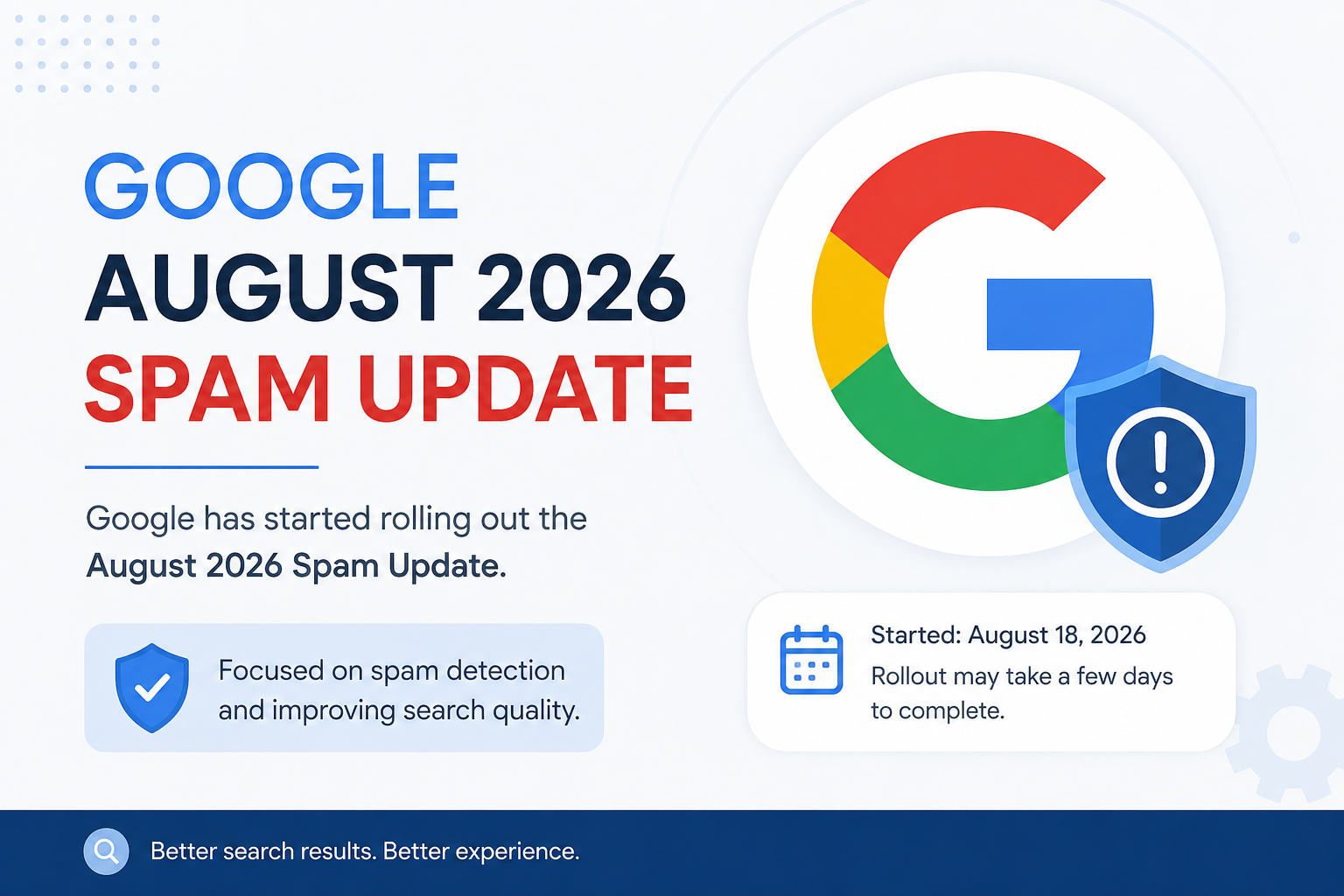
Google has started rolling out a new August 2026 Spam Update, marking another important spam-fighting update aimed at improving the quality and relevance of search results.
The update began rolling out on August 18, 2026, and website owners and SEO professionals should closely monitor rankings, organic traffic, indexing, and overall search visibility during the rollout period.
What Is the August 2026 Spam Update?
The Google August 2026 Spam Update is a Google search algorithm update focused on detecting and reducing spam in search results.
Google regularly releases spam updates to improve its ability to identify websites and content that violate its spam policies. These updates can affect websites that use manipulative SEO techniques, low-quality content, artificial link-building practices, or other tactics designed primarily to influence search rankings.
The current update is being rolled out globally and may result in ranking fluctuations for some websites.
August 2026 Spam Update: Key Details
- Update Name: August 2026 Spam Update
- Start Date: August 18, 2026
- Focus: Spam detection and search quality
- Scope: Global
- Rollout: Gradual
- Potential Impact: Rankings, organic traffic, and search visibility
Because the update is still rolling out, it is too early to determine its full impact. Website performance should be evaluated after the rollout has progressed or completed rather than based on short-term daily fluctuations.
Why Is This Update Important?
Spam updates are important because Google continuously works to ensure that users receive useful, trustworthy, and relevant results.
Websites that follow Google’s search guidelines and focus on providing genuine value to users may be less likely to experience negative effects from spam-focused algorithm changes.
On the other hand, websites relying heavily on manipulative or low-quality SEO practices may experience ranking declines.
This makes the update particularly important for businesses that depend on organic search traffic for leads, sales, and visibility.
The Third Google Spam Update of 2026
The August 2026 Spam Update is notable because it is the third Google spam update announced in 2026.
The previous major spam update was the June 2026 Spam Update.
This continued focus on spam detection highlights the importance of maintaining sustainable SEO practices rather than relying on short-term ranking tactics.
What Should Website Owners Monitor?
During the rollout, website owners should monitor several important SEO metrics.
1. Keyword Rankings
Track important commercial and informational keywords before, during, and after the update.
Look for significant and consistent changes rather than reacting to temporary daily movement.
2. Organic Traffic
Review Google organic traffic in Google Analytics or another analytics platform.
Compare current performance with previous weeks and similar periods to identify whether any changes are directly related to the update.
3. Search Console Performance
Google Search Console can provide useful information about:
- Clicks
- Impressions
- Average position
- Search queries
- Indexed pages
A significant change across multiple pages or keywords may indicate that further investigation is necessary.
4. Indexed Pages
Check whether important pages remain indexed and accessible to search engines.
Technical issues such as accidental noindex directives, robots.txt restrictions, server errors, or access problems should not be confused with algorithmic ranking changes.
5. Website Content Quality
Review pages that have experienced significant ranking changes.
Make sure content is:
- Original
- Useful
- Relevant to the search intent
- Accurate
- Easy to understand
- Written primarily for users
Should You Make Immediate SEO Changes?
Not necessarily.
One of the biggest mistakes during a Google algorithm update is making large website changes based on a few days of ranking fluctuations.
Because the August 2026 Spam Update is still rolling out, it is better to monitor performance and collect enough data before making major strategic changes.
If a website experiences a significant and sustained decline, conduct a detailed SEO audit to determine whether the issue is related to the algorithm update or another factor.
SEO Practices to Avoid
Website owners should be particularly careful about practices that could be interpreted as manipulative or spammy.
These may include:
- Large-scale low-quality content creation
- Keyword stuffing
- Automatically generated pages with little value
- Manipulative link-building
- Unnatural backlinks
- Doorway pages
- Hidden content intended to manipulate rankings
- Duplicate or thin location pages
- Content created primarily for search engines rather than users
The goal should be to build a website that provides genuine value rather than trying to exploit ranking systems.
What If Your Website Was Not Impacted?
If your website has remained stable during the update, there is generally no reason to make unnecessary changes simply because a spam update has been released.
Stable rankings and organic traffic can be a positive indication that the website’s current SEO strategy is working well.
However, continued monitoring is recommended because algorithm updates can produce different effects throughout the rollout period.
What If Your Rankings Drop?
If significant ranking losses occur, don’t immediately assume that the spam update is responsible.
Start with a structured analysis:
- Compare rankings before and after the update.
- Check Google Search Console.
- Review organic traffic.
- Identify which pages and keywords declined.
- Check indexing and technical SEO.
- Review affected content for quality and search intent.
- Analyze backlinks and potential unnatural link patterns.
- Check for recent website changes.
- Compare affected pages with pages that remained stable.
- Make improvements based on evidence rather than short-term fluctuations.
Final Thoughts
The August 2026 Spam Update is another reminder that Google continues to place strong emphasis on search quality and spam detection.
For website owners and SEO professionals, the best approach is to monitor performance, avoid panic-driven changes, and focus on long-term SEO fundamentals.
If rankings and traffic remain stable, continue following a quality-focused SEO strategy. If significant changes occur, investigate the affected pages carefully and identify the underlying cause before implementing corrective actions.
As the rollout continues, more data will become available to determine the broader impact of the August 2026 Spam Update across different industries and types of websites.
The key takeaway: Don’t react to short-term fluctuations. Monitor your data, maintain high-quality content and technical SEO practices, and make strategic changes only when there is clear evidence that they are needed.
Official Reference
For the latest information about the rollout, website owners can refer to Google’s official Search Status Dashboard and monitor the August 2026 Spam Update status there.